
Stock Futures Slide as AI CEOs Call for Slowdown and Oil Surges Past $109
US stock futures fell as AI leaders urge a slowdown in development and oil prices spike after Saudi pipeline shutdown. Nasdaq-100 futures drop 1.7%, Dow down 224 points.

Study4India Team
Expert Educator
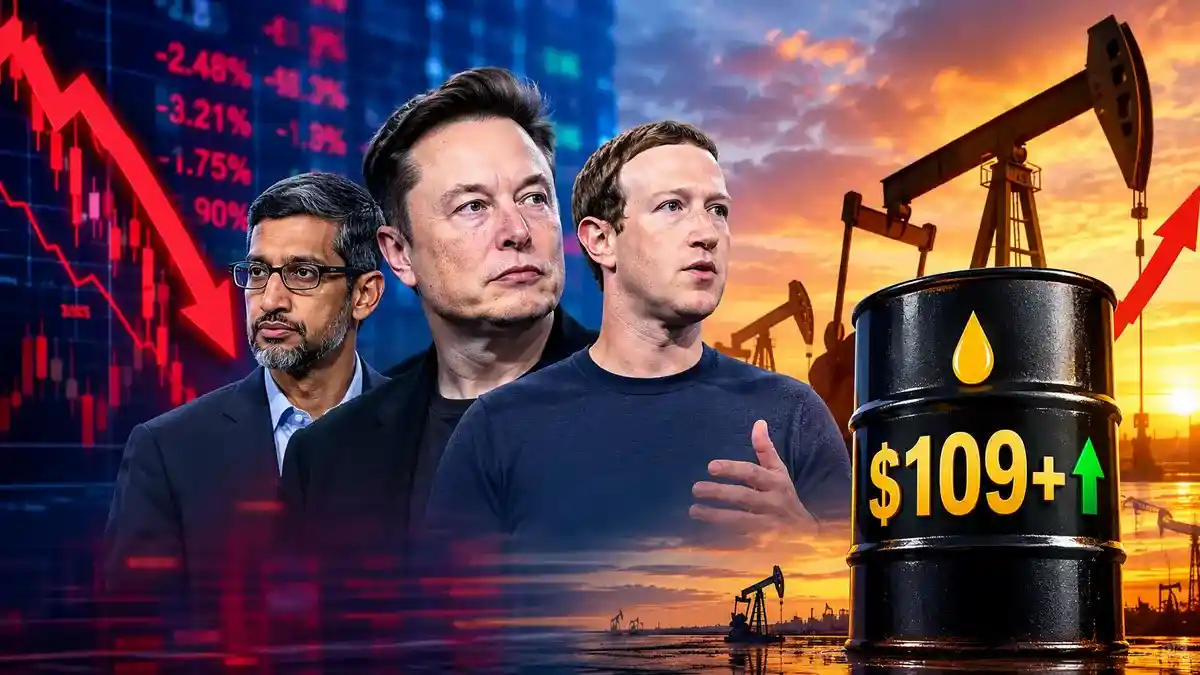
Stock Futures Slide as AI Leaders Call for Slowdown and Oil Prices Surge Past $109
NEW YORK, September 14, 2026 — US equity futures fell sharply on Monday morning as investors grappled with a rare and unsettling development: the very architects of the artificial intelligence boom are now publicly urging the industry to slow down. The coordinated warnings from the heads of Anthropic, OpenAI, and xAI sent shockwaves through global markets, triggering a broad selloff in AI-related stocks from Silicon Valley to Seoul.
Compounding the anxiety, crude oil prices spiked nearly 5% after Saudi Arabia was forced to shut down its critical East-West pipeline that bypasses the Strait of Hormuz — a chokepoint through which roughly one-fifth of the world's oil passes. The dual shock of AI uncertainty and energy supply disruption has left traders bracing for a volatile week ahead, with the Federal Reserve's September policy meeting looming on the horizon.
📊 Market Snapshot — Pre-Market Levels
S&P 500 Futures
▼ 0.7%
Nasdaq-100 Futures
▼ 1.7%
Dow Futures
▼ 224 pts (0.4%)
The AI Safety Shockwave: When the Builders Say "Stop"
The catalyst for Monday's selloff was a remarkable convergence of voices from the top of the AI industry. Over the weekend, Anthropic CEO Dario Amodei published a detailed essay arguing that AI companies must deliberately slow the pace of innovation on their most advanced models, citing escalating safety risks that he described as genuinely existential.
In a Sunday interview with CBS News, Amodei acknowledged the central dilemma of his proposal: what happens if China does not follow suit? It is a question that has divided policymakers and industry leaders alike, and one that President Donald Trump's administration has shown little appetite for entertaining, given the geopolitical stakes of the AI race.
Then came Sam Altman. In a post on X early Monday, the OpenAI chief declared that an IPO this year would be "ill-advised," and called for a federal framework setting consistent safety requirements for frontier AI. Altman warned of two catastrophic scenarios: humanity losing "control of the future to AI," and excessive power concentrating around a single person or company.
"We welcome a federal framework that sets consistent safety requirements for frontier AI. No amount of American competitive pressure should justify recklessness." — Sam Altman, OpenAI CEO
Global AI Stocks Take a Beating
The market response was swift and severe. Semiconductor and AI infrastructure stocks, which have driven much of the 2026 rally, bore the brunt of the selling pressure.
| Company | Pre-Market Move | Sector |
|---|---|---|
| Marvell Technology | ▼ 7.4% | Semiconductors |
| Intel | ▼ 6.0% | Semiconductors |
| Advanced Micro Devices | ▼ 5.0% | Semiconductors |
| Broadcom | ▼ 4.0% | Semiconductors |
| Nvidia | ▼ 2.0% | AI Chips |
The pain was not confined to the United States. In Asia, South Korean memory giants SK Hynix and Samsung Electronics closed down more than 6% and 4% respectively. In Japan, SoftBank — one of OpenAI's largest investors — tumbled 10%. European semiconductor equipment maker ASML fell over 4%, while Infineon dropped more than 6%. Companies with ties to data center buildouts, such as Siemens Energy and Schneider Electric, also traded lower.
🌏 Asia-Pacific Close
Nikkei 225 (Japan): 63,492.99 ▼ 0.81%
Kospi (South Korea): 6,684.37 ▼ 3.26%
CSI 300 (China): 4,480.08 ▼ 0.67%
S&P/ASX 200 (Australia): 8,749.90 ▲ 0.10%
Oil Prices Spike After Saudi Pipeline Shutdown
Just as investors were digesting the AI safety news, a second shock arrived from the Middle East. Saudi Arabia was compelled to close its East-West pipeline — a crucial artery that allows crude to bypass the Strait of Hormuz — after drones launched from Iraq damaged the infrastructure. Riyadh has not disclosed the extent of the damage or the timeline for repairs.
The impact on crude prices was immediate and dramatic:
West Texas Intermediate (WTI)
$104.72
▲ 4.7% — First time above $100 since May
Brent Crude
$109.56
▲ 4.7% — International benchmark
A diplomatic meeting between Iran and Gulf Arab states, originally scheduled for Monday in Oman to discuss the situation in Hormuz, was abruptly postponed following the pipeline attack. The cancellation has only deepened uncertainty about the region's stability and the security of global energy supply chains.
Energy Stocks: The Lone Bright Spot
While tech and AI names cratered, energy stocks emerged as the day's clear winners. The State Street Energy Select Sector SPDR ETF (XLE) climbed more than 1.2% in pre-market trading, with Diamondback Energy, APA, Marathon Petroleum, and EOG Resources each advancing roughly 2%.
In Europe, the UK's FTSE 100 was the standout performer among major indices, rising 0.7% on the back of surging oil majors BP and Shell, both up around 1.5%. It was a rare pocket of green in an otherwise sea of red across global markets.
The Inflation Squeeze Returns
Beneath the headlines of AI and oil lies a slower-burning but equally concerning story: inflation is once again outpacing wage growth in the United States. Consumer prices rose 3.4% year-over-year in August, while average hourly earnings increased just 3.1% — the weakest wage growth recorded since May 2021.
According to Heather Long, chief economist at Navy Federal Credit Union, April marked the turning point after an extended period in which paychecks generally kept pace with rising prices. The resulting squeeze on purchasing power is already visible in consumer behaviour: shoppers are migrating from premium grocers to warehouse clubs and discount retailers in what Long describes as a phenomenon appearing "almost across the income spectrum."
"The frustration is real on inflation and affordability. People who used to shop at Whole Foods are now at Costco, Aldi — you can see that people are still really trying to stretch every dollar." — Heather Long, Chief Economist, Navy Federal Credit Union
What to Watch This Week: The Fed Decision
All eyes now turn to the Federal Reserve's September policy meeting, which concludes later this week. According to CME's FedWatch tool, futures traders are pricing in a roughly 88% probability of a rate hike — an outcome that would add further pressure to equity markets already strained by AI uncertainty and rising energy costs.
A rate hike in this environment would be a significant test of the market's resilience. Higher borrowing costs typically weigh on growth stocks, particularly those in the technology and AI sectors that have driven the bulk of recent gains. Combined with elevated oil prices and softening wage growth, the Fed's decision could set the tone for the remainder of the year.
Other Notable Movers
| Company / Asset | Move | Reason |
|---|---|---|
| Palo Alto Networks | ▲ 4.0% | Cybersecurity demand rises amid AI safety fears |
| CrowdStrike | ▲ 5.4% | Same AI safety tailwind |
| Novo Nordisk | ▲ 1.3% | Rebranding announcement — now "Novo" |
| AstraZeneca | ▲ 1.5% | Breast cancer trial miss seen as "manageable setback" |
| Shein (Hong Kong) | ▼ 10.0% | Contact lens cleaner recall in Australia & New Zealand |
| Z.ai (China) | ▼ 10.0% | $5 billion fundraising; second major raise in two months |
| Spot Silver | ▼ 3.0% | $62.54/oz — traders await Fed decision |
| Spot Gold | ▼ 1.0% | $4,306.19/oz — same Fed anticipation |
Washington Weighs In
The AI safety debate has now reached the corridors of power. Senator Ruben Gallego (D-Arizona), speaking on CNN's "State of the Union" on Sunday, delivered a striking metaphor that captured the moment's urgency:
"Dr. Frankenstein is telling us the monster is escaping; help us stop this. The method that we're answering with is not meeting the moment."
The political pressure follows a researcher's resignation from Anthropic, accompanied by a stark warning that the technology could "kill us all by the end of the decade." That resignation, followed by the unprecedented pledges from Amodei, Altman, and Musk, has created a level of urgency in Washington that few industry issues have generated in recent memory. Lawmakers on both sides of the aisle are now scrambling to understand what regulatory framework — if any — could meaningfully address the risks without ceding America's competitive advantage to China.
The Week Ahead: A Test of Confidence
Last week already delivered a warning shot. The Dow slid 1.6% — its largest weekly loss since March — while the S&P 500 and Nasdaq Composite shed 0.8% and 0.7% respectively. Monday's pre-market action suggests the selling pressure has not abated.
Investors now face a week of compounding uncertainties: the Fed's rate decision, the trajectory of oil prices, the credibility of AI safety pledges, and the broader question of whether the AI-driven rally that has defined 2026 can sustain itself in the face of these headwinds. The answers, as they emerge, will shape the market's direction through the final quarter of the year.
Key Takeaways
- US stock futures fell sharply, with Nasdaq-100 futures down 1.7% as AI stocks sold off broadly.
- Anthropic, OpenAI, and xAI leaders publicly called for slower AI development over safety concerns.
- Oil surged nearly 5% after Saudi Arabia closed a key pipeline bypassing the Strait of Hormuz.
- Energy stocks were the lone bright spot; UK's FTSE 100 outperformed European peers.
- The Fed's September meeting looms with an 88% probability of a rate hike priced in.
- Inflation at 3.4% is once again outpacing wage growth at 3.1%, squeezing consumer purchasing power.
This is a developing story. Market conditions are subject to rapid change. Investors are advised to consult with qualified financial advisors before making any decisions.
Comments (0)
Leave a Reply
Your email address will not be published. Required fields are marked *
No comments yet. Be the first to start the discussion!