
CUET 2027 Master Plan: The Ultimate Step-by-Step Preparation Strategy to Score 100 Percentile
Cracking the Common University Entrance Test (CUET) 2027 requires more than just board exam preparation. Discover the comprehensive, subject-wise strategy, best books, and dynamic study plans to score 100 percentile.

Study4India Team
Expert Educator

The Evolution of College Admissions: Why CUET 2027 Demands a New Approach
The landscape of higher education in India has undergone a massive paradigm shift. The days when a 99% in Class 12 Board Exams guaranteed a seat in premier institutions like Delhi University (DU), Hindu College, SRCC, or Banaras Hindu University (BHU) are officially over. The Common University Entrance Test (CUET), administered by the National Testing Agency (NTA), has democratized admissions, establishing a single, standardized gateway for undergraduate admissions across central, state, deemed, and private universities nationwide.
However, this democratization comes with intense competition. With over 15 lakh students competing for a limited pool of elite seats, CUET has turned into one of the most competitive undergraduate examinations globally. To stand out and secure a 100 percentile in CUET 2027, relying on rote-learning boards strategies will not suffice. You need a highly structured, objective-oriented, and execution-heavy preparation blueprint. This comprehensive guide outlines the exact step-by-step roadmap to dominate CUET 2027.

Figure 1: Navigating the high-stakes environment of CUET requires a balance of speed, accuracy, and deep conceptual clarity.
Key Takeaways
- NCERT is your Bible: Every single direct and indirect question in the Domain Subjects is pulled straight from NCERT textbooks.
- Dual-Track Prep: Learn how to study for your Class 12 Board Exams and CUET simultaneously without burning out.
- The Speed-Accuracy Matrix: Master the art of elimination and time management to handle negative marking.
- Structured Mock Drills: Why analyzing mocks is 10 times more important than just attempting them.
1. Decoding the CUET 2027 Exam Pattern
Before throwing yourself into piles of reference books, you must thoroughly understand the architecture of the weapon you are dealing with. CUET is a Computer-Based Test (CBT) divided into three distinct sections. The flexibility of the exam allows you to choose multiple combinations based on the eligibility criteria of your target universities.
| Section | Content & Syllabus | Questions to Attempt | Duration |
|---|---|---|---|
| Section IA & IB (Languages) | Reading Comprehension, Literary Aptitude, Vocabulary (33 languages available) | 40 out of 50 | 45 minutes per language |
| Section II (Domain Subjects) | Class 12 NCERT Syllabus (27 Domain subjects available) | 40 out of 50 (or 35 out of 45) | 45 mins (60 mins for Math, Physics, Chemistry, Accounts) |
| Section III (General Test) | GK, Current Affairs, Mental Ability, Numerical Ability, Logical Reasoning | 50 out of 60 | 60 minutes |
The Scoring Dynamics: Beware of Negative Marking
Each correct response awards you +5 marks. However, an incorrect response triggers a penalty of -1 mark. This negative marking system makes wild guessing highly counterproductive. A difference of even 2 to 3 marks can slide your rank down by thousands, pulling you out of the running for premium north-campus colleges in Delhi University. Your preparation must prioritize accuracy over mere speed.
2. Phase-Wise Study Timeline for CUET 2027
Success in CUET is a marathon, not a sprint. Trying to cram the entire syllabus in the short gap between your Board exams and the CUET exam is a recipe for disaster. We suggest dividing your prep journey into four distinct, highly productive phases.
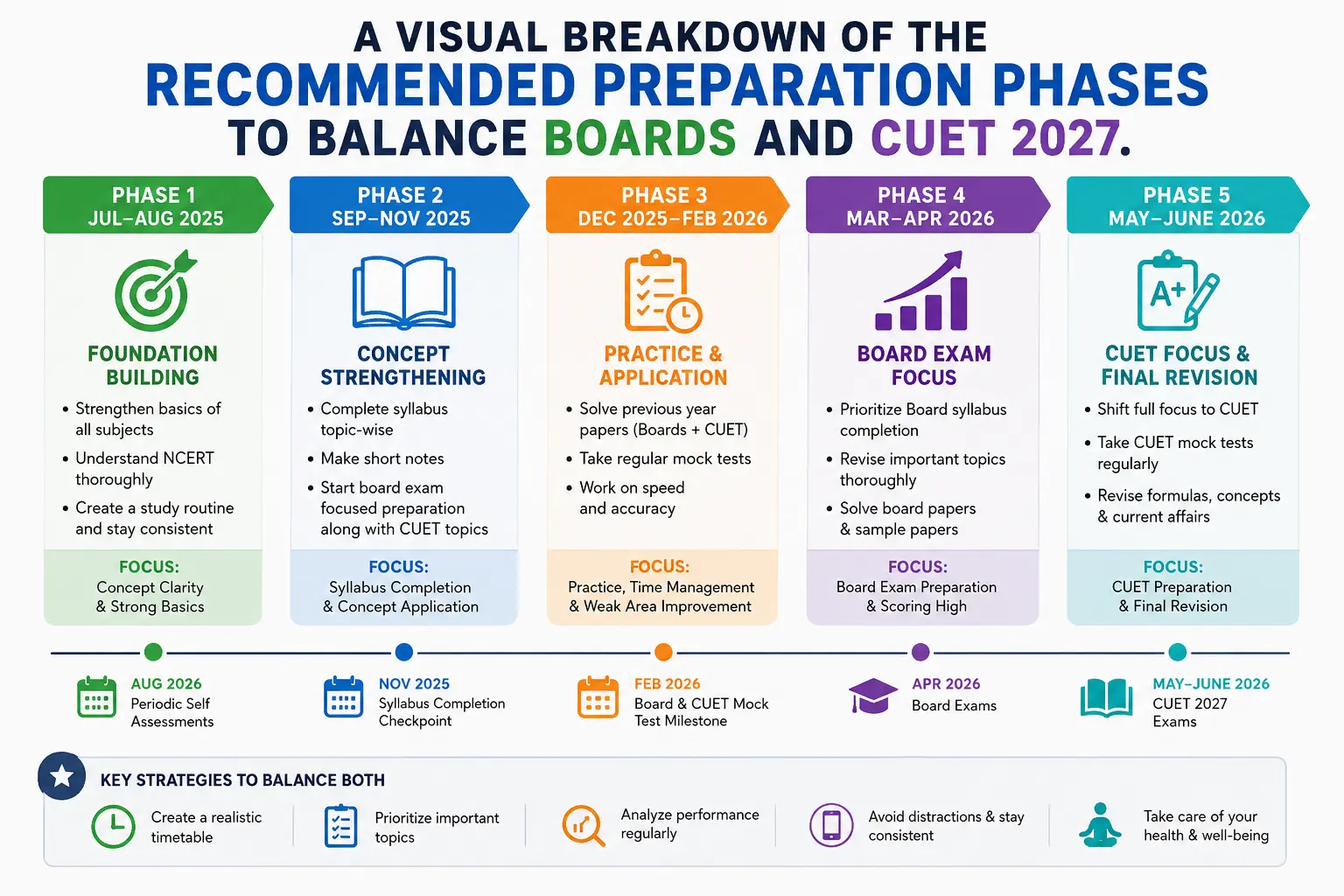
Figure 2: A visual breakdown of the recommended preparation phases to balance Boards and CUET 2027.
Phase 1: Concept Consolidation (June 2026 – November 2026)
This is the foundation-building phase. Your primary objective during this period should be absolute synchronization between your Class 12 curriculum and CUET domains. Since the NTA strictly follows the NCERT syllabus, every topic you study for school must be dissected for competitive exam applications.
- Read each NCERT chapter line-by-line. Highlight critical definitions, historical timelines, exceptions in reactions, or formula derivations.
- Do not skip the side notes, tables, or "Did You Know?" boxes in NCERT books; NTA frequently crafts tricky MCQs directly from these corners.
- Dedicate at least 1 hour every weekend to practice basic Reading Comprehension and basic Quantitative Aptitude (if opting for the General Test).
Phase 2: Board Exam Focus & Objective Tweak (December 2026 – February 2027)
As board pre-boards and practicals approach, your school requirements will naturally increase. However, instead of stopping your CUET prep, merge the two processes. While writing long, descriptive answers for boards, pay attention to the exact keywords. Those keywords frequently become the correct options in CUET's multiple-choice questions.
Phase 3: The Sprint Phase (March 2027 – April 2027)
Once your Board exams wrap up, you enter the high-intensity sprint phase. This is the time to shift completely from subjective writing to objective solving. You must devote 8 to 10 hours daily to revising high-yield topics, practicing timed section tests, and building exam stamina.
Phase 4: Simulated Environments (May 2027 – Exam Day)
During this final stretch, avoid reading new topics. Focus entirely on mimicking the real exam day. Take full-length, multi-subject Computer-Based Mock Tests at the exact time of your scheduled slots to train your brain to perform under high pressure.
3. Section-Wise Master Strategy
Every section in the CUET exam requires a different cognitive approach. Let's break down the precise strategies for all three sections to help you maximize your overall score.

Figure 3: Your resource toolkit: Pairing standard NCERTs with high-quality MCQ banks is vital for Section II success.
Section I: Language Proficiency (The Undervalued Booster)
Many students make the fatal mistake of ignoring Section I, assuming that their basic English or regional language skills will get them through. In reality, the language section is highly competitive and acts as a major rank-decider.
- Reading Comprehension (RC): You will encounter factual, narrative, and literary passages. Master the technique of skimming the questions *before* reading the passage. This saves valuable minutes as you already know what information to look for.
- Vocabulary Building: Dedicate 15 minutes daily to learning synonyms, antonyms, idioms, and one-word substitutions. Use flashcard apps to test yourself during commutes.
- Grammar Fundamentals: Revise structural concepts such as active-passive voice, direct-indirect speech, parts of speech, and spot-the-error drills.
Section II: Domain Subjects (The Core Battleground)
Since your domain scores directly determine eligibility for specific honor programs, aiming for perfect scores here is crucial. Divide your domains into conceptual categories:
Science Stream (Physics, Chemistry, Mathematics, Biology)
- Physics: Focus heavily on formula application, dimensional analysis, and basic conceptual assertions. Solve numerical problems with simple calculations, as complex mathematical derivations are rarely asked.
- Chemistry: Organic chemistry requires regular practice of named reactions, reagents, and mechanisms. For Inorganic, memorize trends in the periodic table (especially block chemistry) directly from NCERT. Physical Chemistry demands direct formula-based numerical practice.
- Mathematics: Focus on Calculus, Matrices, Determinants, and Vector Algebra. Learn speed-solving shortcuts and approximations to solve problems within the strict 60-minute limit.
Commerce Stream (Accountancy, Economics, Business Studies)
- Accountancy: Memorize accounting standards, partner admission/retirement treatments, share forfeitures, and ratio analysis formulas.
- Economics: Pay extreme attention to Microeconomics and Macroeconomics graphs, consumer behavior theories, and budget concepts. Do not neglect the Indian Economic Development textbook, which contains highly testable chronological historical facts.
- Business Studies: Focus on case-study-style MCQs where you must identify management principles or planning steps from a descriptive scenario.
Humanities Stream (History, Political Science, Geography, Sociology)
- Humanities domains are highly factual. Create chronological timelines for History, map-pointing registers for Geography, and catalog structural policy changes for Political Science.
- Use active recall techniques: cover a page of your notes and try to state all the historical dates or constitutional articles from memory.
Section III: The General Test (Aptitude & Awareness)
The General Test is highly dynamic and evaluates your overall intellectual quotient and worldly awareness.
- Quantitative Aptitude: Revise basic mathematical concepts from Class 8 to 10, including Profit & Loss, Simple & Compound Interest, Time-Speed-Distance, Percentages, and basic Geometry.
- Logical Reasoning: Practice coding-decoding, blood relations, syllogisms, seating arrangements, and series completion puzzles daily.
- Current Affairs & GK: Follow a reliable monthly current affairs compilation or watch daily 15-minute news summaries. Focus on major government schemes, national/international awards, sports milestones, and newly appointed dignitaries.
4. The Art of Eliminating Options & Time Management
In a Computer-Based Test like CUET 2027, your ability to manage your screen time and emotional stability is just as important as your academic knowledge. You must develop a system to tackle questions efficiently.

Figure 4: Tracking your mock parameters allows you to spot weak areas and manage time better on exam day.
The Three-Round Solving Technique
Do not try to solve the entire paper linearly from Question 1 to 50. Instead, divide your session into three strategic passes:
- Round 1 (The Low-Hanging Fruits): Go through the paper and answer only those questions you are 100% sure of within 15-20 seconds. This builds immediate psychological confidence and secures a baseline score early on.
- Round 2 (The Calculative Risks): Tackle questions where you have successfully eliminated two options. With a 50% probability of being right, these calculated guesses are statistically beneficial over the long run.
- Round 3 (The Hard Passes): For questions that look completely foreign or require massive calculations, leave them untouched. Remember, avoiding a negative mark (-1) is as good as saving a step on your merit ladder.
5. Crucial Pitfalls to Avoid
Knowing what *not* to do is just as important as knowing what to do. Ensure you avoid these common mistakes during your CUET 2027 preparation:
- Selecting Too Many Domains: Do not select 5 to 6 domains out of fear of missing out. Focus intensely on 3 to 4 domains that you are highly comfortable with. Spreading your focus too thin reduces your chances of scoring 100 percentile in any of them.
- Over-Reliance on Reference Books: Many students waste precious time reading massive, advanced reference books. Stick strictly to the NCERT syllabus. NTA rarely strays outside of these bounds.
- Ignoring Mock Analysis: Merely taking a mock test is useless unless you spend at least an hour reviewing your mistakes. Maintain a dedicated "Error Log" book to write down every conceptual error, silly mistake, or formula omission you make during mocks. Review this log every Sunday.
The Road to 100 Percentile
Cracking CUET 2027 is not an impossible puzzle; it is a systematic, predictable science. The students who secure seats in SRCC, St. Stephen’s, or LSR are not necessarily those who studied 16 hours a day. They are the ones who aligned their preparation with NTA’s specific expectations.
By mastering NCERT concepts early, integrating your Board exam study schedule, and polishing your time-management and option-elimination skills through comprehensive mock drills, you can turn your aspiration of attending your dream university into an inevitable reality. Stay focused, execute your plan consistently, and let your daily habits build your academic future.
Comments (0)
Leave a Reply
Your email address will not be published. Required fields are marked *
No comments yet. Be the first to start the discussion!