
State Finances and Economic Restructuring: An Exhaustive Analysis of the West Bengal Budget 2026-27
An exhaustive analysis of the maiden West Bengal Budget 2026-27 under the new administration, detailing the massive economic restructuring, infrastructure roadmap, and the strategic shift towards targeted welfare.

Study4India Team
Expert Educator
The Dawn of a New Economic Paradigm
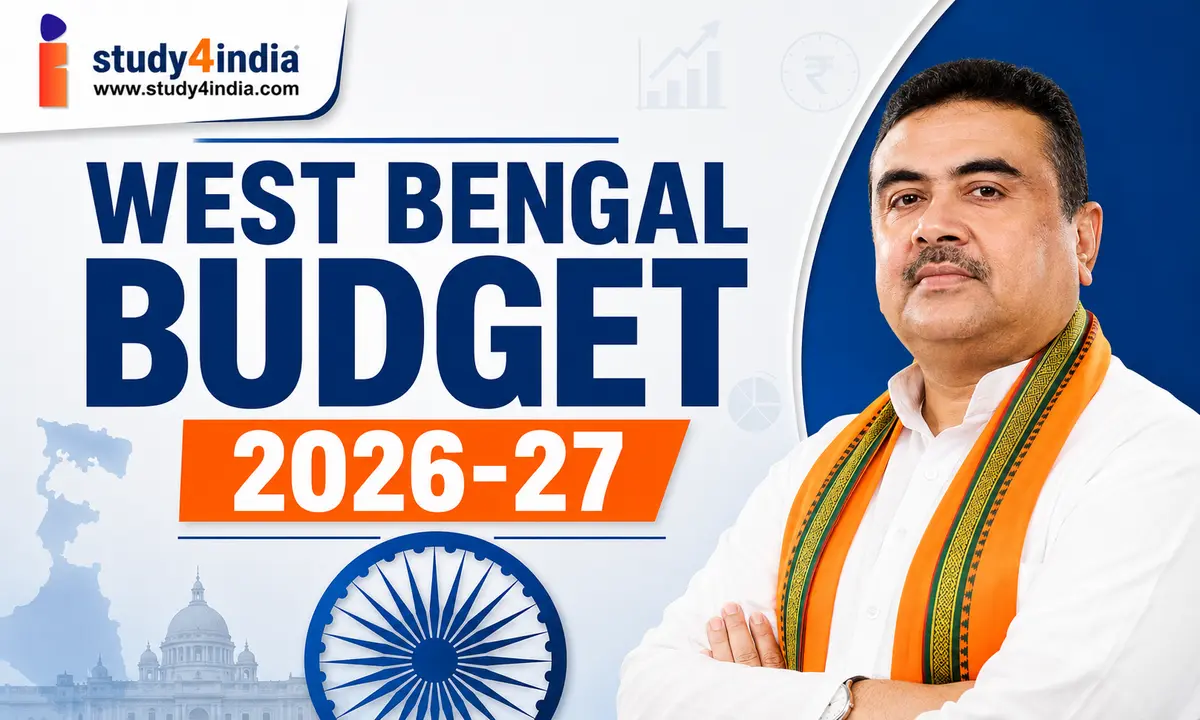
The presentation of the West Bengal Budget for the fiscal year 2026-27 marks a profound structural pivot in the political economy and fiscal trajectory of eastern India. Tabled on June 22, 2026, by Finance Minister Swapan Dasgupta under the leadership of Chief Minister Suvendu Adhikari, this maiden budget of the state's first Bharatiya Janata Party (BJP) government outlines an aggressive, multidimensional blueprint for fiscal consolidation, extensive capital expenditure (capex), and a transition from universal populism to highly targeted welfare. The policy document explicitly departs from the previous administration's isolationist economic posture, embracing central flagship schemes, repealing antiquated land laws to court private capital, and initiating a massive administrative overhaul.
With a total net outlay of ₹4,38,775.29 crore, the budget is framed around the overarching vision of integrating the state into the national developmental matrix, frequently termed the "double-engine" synergy of cooperative federalism. This represents a marked increase from the ₹4.06 lakh crore vote-on-account interim budget presented by the preceding administration earlier in the year. The underlying thesis of the 2026-27 budget is the realization that long-term welfare sustainability in West Bengal is intrinsically tied to rapid industrial revival, stringent debt management, and the optimization of human capital. The Finance Minister noted that the government's development vision is perfectly aligned with the national goal of "Viksit Bharat," aiming to construct a "Viksit Bengal" by leveraging federal resources that were previously untapped due to political friction.
Key Takeaways
- Total net budget outlay set at a record ₹4,38,775.29 crore.
- Unprecedented 20% DA hike for state government employees.
- Launch of 'Annapurna Yojana' with a ₹3,000 monthly payout to targeted beneficiaries.
- Massive push for infrastructure: Kalyani Greenfield Airport and Purba Medinipur Deep-Sea Port.
The Political Economy of the 2026 Transition
To fully grasp the strategic imperatives of this budget, it must be contextualized within the historic political upheaval of May 2026. The West Bengal Legislative Assembly elections fundamentally altered the state's power dynamics, ending the 15-year tenure of the All India Trinamool Congress (AITC/TMC). The BJP secured a landslide victory, capturing 207 of the 294 assembly seats and achieving a vote share of 45.92%, while the incumbent TMC was reduced to 80 seats and a 40.68% vote share. Former Chief Minister Mamata Banerjee also faced a high-profile defeat in her Bhabanipur constituency, culminating in the ascension of Suvendu Adhikari to the Chief Minister's office.
Following the electoral defeat, the opposition TMC experienced an unprecedented internal schism. A massive rebellion led by former Rajya Sabha MP and current MLA Ritabrata Banerjee resulted in the defection of at least 58 to 64 TMC legislators, representing more than two-thirds of the party's remaining strength. These dissident MLAs formed a separate legislative bloc, and Ritabrata Banerjee was officially recognized by Assembly Speaker Rathindra Bose as the Leader of the Opposition (LoP), a decision subsequently upheld by the Calcutta High Court. A parallel rebellion occurred in the Lok Sabha, where two-thirds of the TMC's Members of Parliament merged with the Nationalist Citizens Party of India (NCPI).
This fractured opposition landscape is highly consequential for the state's economic governance. With the primary opposition party internally decimated, the Adhikari administration possesses unprecedented legislative hegemony. This environment allows the government to push through contentious structural reforms—such as the repeal of urban land ceilings, stringent mining e-auctions, and private sector land acquisitions—without the threat of paralyzing floor protests or legislative gridlock.
However, the budget has not been entirely immune to critique. LoP Ritabrata Banerjee, while promising "constructive opposition," flagged several concerns regarding the fiscal roadmap. He cautioned that the administration's aggressive push for "Ease of Doing Business" lacks adequate regulatory safeguards, potentially expanding crony capitalism at the expense of broader economic balance. Furthermore, he critiqued the budget for lacking concrete figures on anticipated private infrastructure investments and vehemently opposed a steep 50% reduction in allocations for the minority sector and madrassa education—which plummeted from ₹5,713 crore in the interim budget to ₹2,165.42 crore.
Macroeconomic Framework and Fiscal Consolidation
The most pressing systemic challenge defining the contours of the West Bengal Budget 2026-27 is the state's precarious fiscal health. During his budget presentation, Finance Minister Dasgupta transparently acknowledged an inherited outstanding debt burden of ₹8.15 lakh crore. This staggering liability is a legacy of prolonged revenue deficits and a heavy reliance on market borrowings to fund recurring, non-asset-creating welfare expenditures over the preceding decade. The debt overhang severely constricts the state's fiscal maneuverability; annual interest payments alone consume upwards of ₹49,000 crore to ₹53,033.97 crore, effectively neutralizing a quarter of the state's annual revenue receipts.
Deficit Targeting and Debt Management
Despite the immense debt servicing requirements, the budget projects a highly optimistic trajectory for fiscal correction. The administration has targeted a reduction in the revenue deficit to 1.02% of the Gross State Domestic Product (GSDP), a sharp contraction from the revised 2.07% (or 2.4% by alternative estimates) of the 2025-26 fiscal year. In absolute numerical terms, the revenue deficit is projected to shrink dramatically by over 46%, falling to ₹21,984.41 crore from a revised ₹41,164.05 crore.
The fiscal deficit is similarly targeted to contract to 2.91% of GSDP, safely below the 3% prudential ceiling mandated by the 16th Finance Commission and the Fiscal Responsibility and Budget Management (FRBM) framework. This is a vital correction from the 3.40% to 4.0% deficit levels recorded in recent revised estimates. Concurrently, the debt-to-GSDP ratio is projected to ease marginally from 38.29% to 37.98%.
| Fiscal Indicator | 2025-26 (Revised Estimates) | 2026-27 (Budget Estimates) | Fiscal Shift |
|---|---|---|---|
| Total Budget Outlay (Net) | ₹3.96 lakh crore | ₹4,38,775.29 crore | + 10.8% |
| Outstanding Debt | - | ₹8.15 lakh crore | Baseline Established |
| Debt-to-GSDP Ratio | 38.29% | 37.98% | - 31 bps |
| Revenue Deficit (% of GSDP) | 2.07% | 1.02% | - 105 bps |
| Fiscal Deficit (% of GSDP) | 3.40% | 2.91% | - 49 bps |
| Total Revenue Receipts | ₹2,44,866.90 crore | ₹3,20,484.85 crore | + 30.8% |
| Total Capital Receipts | ₹1,01,794.71 crore | ₹1,08,288.44 crore | + 6.3% |
| Central Grants-in-Aid | ₹22,068.85 crore | ₹71,393.19 crore | + 223.5% |
Revenue Buoyancy and Federal Integration
The mathematical feasibility of this rapid fiscal consolidation—particularly while simultaneously enhancing welfare payouts and capital outlays—relies almost entirely on an unprecedented surge in federal fiscal transfers. Grants-in-Aid from the Central Government are projected to leap exponentially from a revised estimate of ₹22,068.85 crore in 2025-26 to a staggering ₹71,393.19 crore in 2026-27. This massive influx of federal capital, unlocked by the state's newfound willingness to implement centrally sponsored schemes (CSS), provides the exact fiscal liquidity required to fund legacy debt servicing without defaulting on capital infrastructure obligations.
Domestically, the state projects robust buoyancy in its own tax revenues, estimating collections to reach ₹1,30,669.68 crore, up from ₹1,11,737.13 crore the previous year. This growth is anchored by State Goods and Services Tax (SGST) collections, projected to generate ₹61,535 crore, and state excise revenues, estimated at ₹24,922 crore.
To augment non-tax revenues without imposing direct burdens on the common taxpayer, the government announced sweeping reforms in the mining sector. The state will mandate the centralized e-auctioning of minor minerals—including sand, stone, and granite—to plug systemic leakages, eliminate illegal extraction cartels, and formalize the sector, thereby funneling previously illicit capital directly into the state exchequer.
Taxation Reforms and Compliance Easing
In alignment with its "Ease of Doing Business" mandate, the finance department introduced several tax simplification measures aimed at reducing compliance friction. The exemption thresholds for professional tax have been significantly expanded. For salaried individuals, the monthly exemption limit was doubled from ₹10,000 to ₹20,000. For self-employed professionals, the annual exemption threshold surged from ₹60,000 to ₹2.5 lakh, while for traders and commercial establishments, the gross receipt threshold for tax liability was raised from ₹5 lakh to ₹10 lakh. Furthermore, personnel of the Border Security Force (BSF) posted in West Bengal have been granted a complete exemption from professional tax.
In the excise domain, the government moved to alleviate the compliance burden on the pharmaceutical sector by amending the West Bengal Excise Rules, 2025. Homoeopathic medicine manufacturers utilizing industrial spirit are no longer required to obtain licenses and pay exorbitant fees to the state excise directorate, a move designed to stimulate local pharmaceutical manufacturing. Concurrently, to address public health and social order, the state enacted strict zoning laws for alcohol sales; no new liquor licenses will be granted within a 1-kilometer radius of educational institutions, hospitals, or religious shrines, with the limit set at 500 meters within the highly dense Kolkata Municipal Corporation (KMC) jurisdiction.
Departmental Allocations: A Strategic Shift
An analysis of the departmental allocations reveals the government's strategic intent to pivot from purely consumption-driven expenditure to asset-creating capital outlays, while simultaneously fulfilling basic rural and social mandates. The total expenditure for 2026-27 is projected at ₹4,28,775.29 crore (gross expenditure exceeding ₹4.38 lakh crore before recoveries), with Social Services accounting for ₹1,80,862.37 crore and Economic Services receiving ₹73,773.66 crore.
| Key Department / Sector | Allocation 2026-27 (₹ in Crore) | Strategic Focus |
|---|---|---|
| Women, Child Dev. & Social Welfare | ₹52,308.00 | Annapurna Yojana, demographic targeting |
| Panchayats & Rural Development | ₹51,836.55 | VB-G RAM G (MGNREGA), rural housing, roads |
| School Education | ₹44,948.21 | Teacher recruitment, model schools |
| Health & Family Welfare | ₹22,338.08 | Medical colleges, Ayushman Bharat |
| Home & Hill Affairs | ₹16,439.12 | Police recruitment, modernization |
| Agriculture | ₹10,463.12 | PM-KISAN state top-up, PMFBY rollout |
| Food & Supplies | ₹10,408.37 | Maa Aahar expansion, public distribution |
| Higher Education | ₹6,858.69 | New universities, female stipends |
| Minority Affairs & Madrasah Edu. | ₹2,165.42* | Sectoral rationalization and restructuring |
| Irrigation and Waterways | ₹4,214.10 | Ghatal Master Plan, flood control |
Rationalization of the Welfare Architecture
A defining characteristic of the political transition in West Bengal was the fierce debate over the sustainability of social safety nets. The 2026-27 budget signals a strategic, calculated shift from universal, unconditional populism to highly targeted, data-driven direct benefit transfers (DBT). Finance Department officials indicated that while the absolute quantum of social sector spending would remain robust, the era of unchecked beneficiary expansion has concluded.
The Annapurna Yojana: Precision Over Populism
The previous administration's flagship 'Lakshmir Bhandar' scheme, which provided broad-based monthly cash transfers to women, has been fundamentally restructured and rebranded as the 'Annapurna Yojana'. The budget allocates a massive ₹36,000 crore to this specific scheme, promising an enhanced direct cash transfer of ₹3,000 per month to eligible women aged 25 to 60.
However, the underlying economics of this enhancement reveal a rigorous rationalization process. Through strict Know Your Customer (KYC) verification and Aadhaar seeding to eliminate systemic duplication, the state has actively weeded out approximately 30 lakh ineligible or ghost beneficiaries. Consequently, the total beneficiary pool has been intentionally narrowed from roughly 2.4 crore women under the previous regime to a highly targeted 1 crore women. This consolidation ensures that the substantial ₹3,000 monthly payout reaches the most economically vulnerable households, acting as a high-powered fiscal multiplier that stimulates local rural consumption while preventing the state exchequer from bleeding funds on non-merit subsidies.
Additionally, to promote female mobility and workforce participation, the budget allocates ₹550 crore to provide free transportation for women on state-run buses, operationalized through the imminent rollout of a biometric 'Pink Card' system. Pregnant women will also receive financial assistance of ₹21,000 alongside six nutritional kits under the PM Matri Vandana Yojana.
Expanding Peripheral Safety Nets
The budget maps out comprehensive lifecycle support through various targeted interventions. The monthly allowance for senior citizens, widows, and persons with disabilities has been uniformly enhanced by ₹500, elevating the baseline pension from ₹1,000 to ₹1,500 per month.
To address the state's acute youth unemployment crisis, the administration introduced the 'Bhorsha Kormosuchi' (or 'Bharosa') assistance program. It guarantees a monthly allowance of ₹3,000 to eligible unemployed graduates (aged 21 to 45) and ₹2,000 for non-graduates, provided their annual family income is below ₹1 lakh and they are not beneficiaries of other state welfare protections.
Recognizing specific cohorts that influence public narrative, the budget institutes a monthly pension of ₹5,000 for retired journalists. More controversially, it introduces the 'Sangrami Bhata', a ₹10,000 monthly allowance for individuals who were incarcerated for political reasons under the previous government—a clear ideological nod to the BJP's grassroots political base that faced severe attrition and legal action during the preceding administration.
E-Governance and the "Apnar Sarkar, Apnar Pashe" Initiative
To bypass lower-level bureaucratic corruption and syndicate interference in welfare delivery, the Chief Minister launched the 'Apnar Sarkar, Apnar Pashe' (Your Government, At Your Assistance) initiative. Anchored by a toll-free helpline and an integrated web portal linked directly to the Chief Minister's Office (CMO), this centralized grievance redressal mechanism allows citizens to directly report issues related to welfare scheme delivery, old-age pensions, and municipal services. To utilize the portal, citizens authenticate via OTP and input granular demographic data, allowing the state to track geographic clusters of administrative failure. The Finance Minister has also committed to digitizing the entire administrative workflow, announcing a transition to a completely "paperless" government architecture to ensure transparency.
Public Sector Employment and Labor Economics
The administration’s labor strategy directly addresses two of the most volatile political flashpoints in West Bengal over the last decade: the prolonged stagnation of public sector recruitment and the severe disparity in Dearness Allowance (DA) between state and central government employees.
The 20% DA Shockwave
Fulfilling a primary electoral pledge that galvanized the state's bureaucratic machinery, Finance Minister Dasgupta announced a massive 20 percentage point hike in the Dearness Allowance for state government employees and Dearness Relief (DR) for pensioners, effective October 1, 2026. This unprecedented single-tranche elevation raises the total DA from a stagnant 18% to 38%.
This policy intervention is macroeconomically significant. For years, state employees engaged in intense legal battles and prolonged strikes as the DA gap between them and central government employees (who currently receive upwards of 50%) widened dramatically. The 20% hike actively narrows this disparity to 22 percentage points. While this imposes a heavy recurring liability on the state’s committed revenue expenditure, it serves as a massive, immediate liquidity injection into the urban and semi-urban middle class, likely spurring aggregate demand in the real estate, consumer durables, and retail sectors just ahead of the festive season.
Mass Recruitment and Frontline Honorariums
Reversing the state's notorious recruitment freeze, the budget commits to the phased filling of 1,00,000 public sector vacancies within the current fiscal year. The structural breakdown of these jobs reflects critical governance gaps: 20,000 positions in the police department to bolster law enforcement, 50,000 teaching and non-teaching posts to resolve the paralysis in the school education system, and 1,000 roles in the Industrial Frontiers/Rifles division.
Crucially, the government has mandated a 33% horizontal reservation for women across these new appointments to boost female labor force participation, alongside a 10% quota for 'Agniveers' where applicable, seamlessly aligning state policy with central defense recruitment strategies. To accommodate candidates who lost eligibility during the years of recruitment stagnation, the existing five-year relaxation in the upper age limit for government jobs has been extended for another two years.
Simultaneously, the administration recognized the economic vulnerability of the state's frontline contract workers. Monthly honorariums have been hiked substantially: Anganwadi workers, ASHA workers, and para-teachers will receive an increase of ₹5,000 per month. Civic volunteers, Green Police, Home Guards, National Volunteer Force (NVF) personnel, and rural livestock extension workers will see a ₹2,000 monthly raise starting August 2026, while mid-day meal cooks will receive an extra ₹1,000 per month. The budget also proposed the establishment of a dedicated welfare board for gig workers.
Industrial Resurgence and the Demise of the 'Syndicate'
West Bengal’s deindustrialization over recent decades has historically been attributed to hostile land acquisition laws, extortionist local cartels (colloquially known as "syndicates"), and severe regulatory friction. The 2026-27 budget aggressively seeks to dismantle these barriers to reposition the state as the premier manufacturing and investment destination in Eastern India.
Land Reforms and Ease of Doing Business
A watershed announcement in the budget is the government's commitment to re-examine and overhaul the West Bengal Urban Land (Ceiling and Regulation) Act (ULCRA), 1976. For decades, ULCRA severely restricted corporate entities from holding large tracts of contiguous land in urban agglomerations. By signaling the reform or outright repeal of this act, the government aims to unlock vast swaths of developable land for mega industrial parks, logistics hubs, and commercial real estate. Furthermore, to revitalize the ailing plantation economy, the permissible limit for commercial land use in tea gardens has been slashed from 30% to 15%, striking a balance between commercial monetization and environmental preservation.
To directly incentivize capital inflow, a dedicated corpus of ₹5,000 crore has been established specifically for industrial subsidies, effectively reversing the previous administration's withdrawal of such fiscal sweeteners. Under the new West Bengal Investment Promotion Framework, investments exceeding ₹100 crore will completely bypass local-level municipal red tape through a mandatory, time-bound single-window statutory clearance system.
Indicating a definitive shift toward a modern 24/7 economy, the government proposes special operational licenses allowing corporate IT offices, retail shops, and restaurants to remain open around the clock. Finance Minister Dasgupta explicitly stated that stringent new legislation would be introduced to safeguard businesses from the "Syndicate Raj"—informal extortion networks that historically monopolized local supply chains.
Emerging Technologies and MSME Growth
The budget intentionally pivots away from traditional heavy manufacturing to embrace deep tech, green energy, and emerging industrial corridors. A dedicated Artificial Intelligence (AI) Mission has been launched, alongside a ₹5,000 crore comprehensive package directed toward the Micro, Small, and Medium Enterprises (MSME) sector and semiconductor development.
Durgapur has been earmarked as the site for a new semiconductor manufacturing unit, while Siliguri will host a sprawling 50,000 square feet IT and semiconductor hub. A robust new Startup Policy backed by twin dedicated funds (₹40 crore and ₹60 crore) will inject venture capital into the state's entrepreneurial ecosystem. The state also emphasized green transitions, planning new solar power plants to meet a projected peak electricity demand surge, alongside the deployment of 4,000 electric buses.
Capital Expenditure: The Infrastructure Roadmap
The administration recognizes that rapid industrialization requires world-class logistics and connectivity. The state's capital expenditure strategy, allocated ₹86,533.10 crore, relies heavily on establishing massive transport multipliers.
Aviation and Port Infrastructure
To alleviate the acute passenger and cargo congestion at the Netaji Subhash Chandra Bose International Airport in Dum Dum, the government announced plans to identify 1,000 to 1,500 acres of land in Kalyani (approximately 60 km from Kolkata) for a massive new greenfield airport. Concurrently, regional air connectivity is being rapidly decentralized. New regional airports are proposed in Purulia, Balurghat, and Malda under the central government's UDAN scheme, alongside runway expansion in Cooch Behar.
On the maritime front, a long-pending, geopolitically significant proposal for an integrated deep-sea port at Dadanpatrabar in Purba Medinipur has been officially greenlit and funded. This port aims to bypass the draft limitations of riverine ports, reclaiming West Bengal’s position as the primary maritime logistics gateway for the landlocked Northeast.
Urban and Rural Connectivity
Urban mass transit is slated for expansion beyond the capital region. The government ordered immediate feasibility surveys for Metro rail services in the tier-II industrial cities of Durgapur, Asansol, Siliguri, and Jalpaiguri. In Kolkata, ₹900 crore has been allocated to construct a critical elevated transport corridor connecting Chingrighata to New Town.
Rural and regional flood control sees the decisive allocation of ₹1,200 crore for the Ghatal Master Plan. Furthermore, ₹1,200 crore has been sanctioned for a vital four-lane bridge over the Bhagirathi/Mayurakshi river in Birbhum, and ₹100 crore dedicated solely to strengthening cyclonic communication infrastructure in the Sundarbans.
| Key Infrastructure Project | Location / Region | Strategic Focus / Allocation |
|---|---|---|
| Kalyani Greenfield Airport | Kolkata Metropolitan Area | 1,000 - 1,500 acres; passenger decongestion |
| Integrated Deep-Sea Port | Dadanpatrabar, Purba Medinipur | High-draft maritime trade and logistics |
| Elevated Corridor | Chingrighata to New Town, Kolkata | ₹900 Crore; easing IT sector commutes |
| Ghatal Master Plan | Paschim Medinipur | ₹1,200 Crore; persistent flood mitigation |
| Bhagirathi/Mayurakshi Bridge | Birbhum / Murshidabad | ₹1,200 Crore; regional connectivity |
| Regional Airports (UDAN) | Purulia, Balurghat, Malda | Tier-II/III commercial air connectivity |
| Metro Rail Feasibility Studies | Durgapur, Asansol, Siliguri | De-centralizing urban mass transit |
Human Capital: Healthcare and Educational Restructuring
The budget operates on the premise that West Bengal’s human capital indices require urgent, massive recapitalization to meet the demands of a high-tech modern economy. This translates into unprecedented outlays for education and health, effectively ending the state’s previous refusal to participate in central integration schemes.
Educational Revitalization
The School Education Department secured the third-highest departmental allocation in the budget at ₹44,948.21 crore. To combat basic nutritional deficits, the mid-day meal ingredient allocation has been increased from ₹6.78 to ₹10 per student. In a novel public-private partnership, ISKCON has been roped in to assist in food preparation in KMC areas. Additionally, ₹2,100 crore has been earmarked for the establishment of state-of-the-art model schools.
Higher education receives a geographic rebalancing. Fulfilling a major BJP manifesto promise, the budget proposes the establishment of an Indian Institute of Technology (IIT) and an Indian Institute of Management (IIM) in North Bengal. In the tribal-dominated Jangalmahal region, a dedicated Tribal University is being established in Jhargram alongside two new Kendriya Vidyalayas.
To address gender parity, an innovative scheme offers a one-time grant of ₹50,000 for unmarried girls entering college, specifically engineered to lower the female dropout rate. Recognizing the fierce competition for employment, the state will establish free competitive examination coaching centers across all districts.
Healthcare and 'Ayushman Bharat' Integration
Reversing years of bitter political standoff, the West Bengal government officially integrated the state into the central Ayushman Bharat scheme. The budget allocates ₹3,100 crore to facilitate this transition, extending a ₹5 lakh annual cashless health cover to nearly seven crore residents.
The physical medical education infrastructure is expanding with four new medical colleges strategically located in Alipurduar, Kalimpong, Dakshin Dinajpur, and Paschim Bardhaman. Furthermore, North Bengal is slated to receive its own All India Institute of Medical Sciences (AIIMS). To reduce out-of-pocket health expenditures, the government launched the 'Amrit Yojana', mandating pharmacies in state medical colleges where life-saving drugs will be available at 50% to 90% discounts.
Agrarian Economics and Rural Development
To rectify the spatial distribution of wealth, the 2026-27 budget directs its absolute highest sectoral outlay—an immense ₹51,836.55 crore—to the Panchayats and Rural Development Department.
Empowering the Agrarian Base
The agricultural strategy represents a paradigm shift toward central frameworks. The state formally adopted the Pradhan Mantri Fasal Bima Yojana (PMFBY) with a combined outlay of about ₹12,200 crore. Furthermore, the state government announced a supplementary top-up of ₹3,000 per farmer family annually under PM-KISAN, provided over and above the ₹6,000 central grant.
The rural employment guarantee framework is also being fortified, allocating ₹14,000 crore to ensure up to 125 days of guaranteed wage employment executed strictly through KYC-verified job cards. Additionally, ₹13,000 crore has been secured for rural housing infrastructure under the PM Awas Yojana.
Administrative Decentralization and Cultural Branding
District Reorganization and Municipal Expansion
Recognizing administrative bloat, the government proposed the creation of five new districts: Kolkata (redefined borders), Basirhat, Sundarban, Jangipur, and Arambagh. This is accompanied by the creation of seven new municipalities. To decentralize legislative power, the annual Member of Legislative Assembly Local Area Development Fund (MLA LADF) has been increased by nearly 43% to ₹1 crore per constituency.
Cultural Heritage and Tourism
The budget allocates substantial resources to cultural preservation. A modern museum will be established to mark the 150th anniversary of 'Vande Mataram', and a 'Tagore Cultural Centre' will be built. Capitalizing on spiritual heritage, the government proposed the creation of a 'Bengal Shakti Peeth Circuit' connecting shrines like Kalighat and Tarapith. Symbolically, July 6, the birth anniversary of Dr. Syama Prasad Mookerjee, was declared an official state holiday.
Conclusion
The West Bengal Budget 2026-27 represents far more than a routine annual financial statement; it is an aggressive, exhaustive manifesto for structural economic restructuring. Finance Minister Swapan Dasgupta has attempted an incredibly intricate fiscal balancing act: fulfilling massive, immediate populist promises—such as the historic 20% DA hike, the recruitment of 1 lakh public servants, and the ₹36,000 crore Annapurna Yojana—while simultaneously projecting a reduction in the revenue deficit and laying the capital groundwork for deep-tech industrialization.
The macroeconomic strategy relies on a rapid pivot toward federal integration. By pruning beneficiary lists and integrating fully with Central Government schemes, West Bengal is unlocking massive tranches of federal funding. This federal capital is being aggressively re-routed into capex-heavy infrastructure.
However, the shadow of the ₹8.15 lakh crore inherited debt looms over these ambitions. The ultimate success of this budget relies entirely on flawless execution. If the proposed land reforms and "Ease of Doing Business" initiatives attract private capital, the state can generate the organic tax revenues needed. Supported by absolute legislative dominance, the 2026-27 budget serves as a highly ambitious, capex-driven 'Marshall Plan' for West Bengal, banking heavily on the synergy of the "double-engine" framework.
Comments (0)
Leave a Reply
Your email address will not be published. Required fields are marked *
No comments yet. Be the first to start the discussion!