
Why Your Indian Passport Doesn't Prove Citizenship (And the Real Purpose of the NRC)
Does holding an Indian passport or Voter ID make you a legal citizen? Indian courts say no. We break down the complex legalities of citizenship proofs and explore whether the NRC was meant to be the ultimate solution.

Study4India Team
Expert Educator
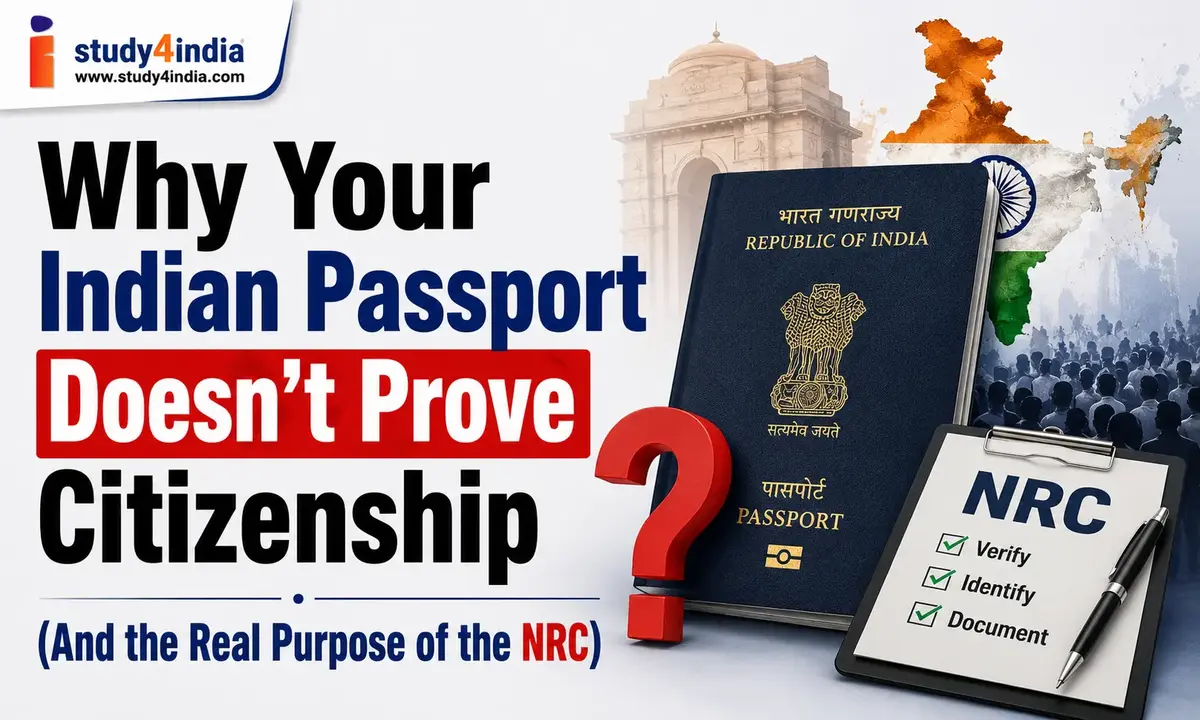
The Great Document Illusion
Imagine this: You carry a sleek, navy-blue Indian passport with the golden emblem of the Ashoka Chakra. You have an Aadhaar card linked to your bank account, a PAN card for your taxes, and a Voter ID that you use in every election. If anyone were to question your nationality, you would confidently present these documents. But here is the legal shocker: None of these documents absolutely prove that you are an Indian citizen.
This isn't a bureaucratic loophole; it is established Indian legal precedent. In a series of landmark judgments over the past decade, various High Courts (including the Bombay and Gauhati High Courts) have explicitly stated that passports, Voter IDs, and Aadhaar cards do not constitute definitive proof of citizenship. This legal paradox leaves millions wondering: if the government-issued documents we rely on every day aren't enough, what actually makes someone a citizen? And more importantly, was the highly controversial National Register of Citizens (NRC) designed to fix this exact mess?
Key Takeaways
- A passport is legally defined as a travel document, not a certificate of citizenship.
- Aadhaar explicitly states on the card itself that it is proof of identity, not citizenship.
- Citizenship in India is determined by strict bloodline and birthright timelines under the Citizenship Act of 1955.
- The NRC was originally conceptualized as the singular, definitive registry to end the documentary confusion.
1. Why Your Passport Fails the Ultimate Test
To understand why a passport falls short, we have to look at the law that governs it. Passports are issued under the Passports Act, 1967. The primary function of this act is to regulate the departure of Indians from India and to provide them with a travel document recognized internationally.
While the passport authority does conduct police verifications and background checks, these checks are primarily designed to verify your identity, criminal record, and current address. They do not rigorously investigate your ancestral lineage to determine if you strictly meet the criteria of the Citizenship Act, 1955. In legal terms, a passport offers prima facie (at first sight) presumption of citizenship, but it is entirely rebuttable. If the state suspects you obtained the passport fraudulently or are an illegal immigrant, the passport itself cannot be used as your defense in a Foreigners Tribunal.
2. The Aadhaar and Voter ID Fallacy
The misconception extends beyond passports. Let's break down the other "pillars" of Indian identity:
- Aadhaar: The Unique Identification Authority of India (UIDAI) has aggressively clarified that Aadhaar is strictly a proof of residence. Any individual who has resided in India for 182 days in the 12 months preceding their application is eligible for Aadhaar, regardless of their nationality.
- Voter ID (EPIC): While the Representation of the People Act mandates that only citizens can vote, the reality of electoral roll compilation is notoriously flawed. Courts have routinely noted that inclusion in a voter list is often based on superficial local inquiries, making it unreliable as absolute legal proof of citizenship in a tribunal setting.
- PAN Card: Issued by the Income Tax Department, PAN is purely for financial tracking. Foreign nationals working in India hold Indian PAN cards.
| Document | What People Think It Proves | What It Legally Proves | Issued Under |
|---|---|---|---|
| Passport | Citizenship | Identity & Right to Travel | Passports Act, 1967 |
| Aadhaar Card | Citizenship / Identity | Identity & Residence (182+ days) | Aadhaar Act, 2016 |
| Voter ID (EPIC) | Citizenship | Electoral Roll Inclusion | Rep. of the People Act, 1950 |
| Pre-1987 Birth Certificate | Age / Date of Birth | Absolute Citizenship (By Birth) | Citizenship Act, 1955 |
3. So, How Do You Actually Prove Citizenship?
If modern IDs don't work, proving citizenship becomes a time-traveling paperwork nightmare. Under the Citizenship Act of 1955, citizenship in India is primarily determined by Jus Sanguinis (right of blood) rather than strictly Jus Soli (right of the soil), with specific cutoff dates:
- Born before July 1, 1987: You are a citizen by birth, regardless of your parents' nationality.
- Born between July 1, 1987, and Dec 3, 2004: You are a citizen if at least one parent was an Indian citizen at the time of your birth.
- Born after Dec 3, 2004: You are a citizen only if both parents are Indian citizens, or one is a citizen and the other is not an illegal migrant.
Therefore, to legally prove your citizenship today, you often have to prove your parents' or grandparents' citizenship. This requires producing legacy data: decades-old land records, pre-independence educational certificates, or foundational birth registries. For millions of poor, marginalized, or disaster-affected Indians who never possessed such legacy paperwork, this is nearly impossible.
4. Enter the NRC: The Ultimate Registry?
This documentary chaos is exactly what the National Register of Citizens (NRC) was theoretically supposed to resolve. The NRC was first prepared in 1951 following the census. However, its modern iteration was undertaken in Assam under the supervision of the Supreme Court to weed out illegal immigrants from neighboring Bangladesh.
The core premise of the NRC was simple, albeit brutal: Force every resident to produce legacy data proving their ancestors lived in India before a specific cutoff date (Midnight, March 24, 1971, for Assam). Those who made the list would be permanently classified as bona fide citizens. The register would become the ultimate, indisputable proof of Indian citizenship, superseding the need for passports or Voter IDs in citizenship disputes.
Why the Solution Became a Nightmare
While the theory of a definitive national registry sounds administratively neat, the execution in Assam was a humanitarian crisis. The burden of proof was entirely on the citizen. When the final Assam NRC was published in 2019, over 1.9 million people were excluded.
Many of those excluded were not illegal immigrants but genuine citizens—often illiterate laborers, flood victims whose homes washed away, or women whose names changed after marriage—who simply could not produce 50-year-old paperwork. The realization that millions of rightful citizens could be rendered stateless due to a lack of legacy documents is what sparked massive nationwide protests against the proposed nationwide NRC.
The Bottom Line
We exist in a bizarre legal paradox. The documents we rely on to fly internationally, pay taxes, and elect our Prime Minister are not legally sufficient to prove we belong to the nation.
The NRC was conceptualized as the ultimate fix to this problem—a singular ledger to end all ambiguity. However, the Assam experiment proved that in a developing nation with poor historical record-keeping, demanding strict legacy documentation causes more chaos than it cures. Until the government introduces a unified, accessible, and humane method of defining and certifying citizenship, the Indian Passport will remain an essential, yet legally incomplete, badge of identity.
Comments (0)
Leave a Reply
Your email address will not be published. Required fields are marked *
No comments yet. Be the first to start the discussion!